Thinking about a Tesla? Two things to understand: how fast it charges and what to install at home. Here’s a quick chart by model, plus our recommendations. Let’s dive in!
Say Hello to Convenience With At-Home Tesla Charging
Tesla has come a long way. It’s seen exponential growth almost every year since the first Model S, and arguably pulled the whole industry into the electric era.
Quiet ride, quick 0-60, many pros. Customer service can be a pain, but most owners happily trade that for lower costs and no gas runs. With a Level 2 charger at home, you wake up to a full “tank.”
As a quick refresher, there are two options for EV charging installation at home:
Level 1 EV Charging: Also referred to as “trickle charging” using a regular household outlet to charge your electric car. This can take up to 4 days or more to achieve a full charge.
Level 2 EV Charging: At electrical outputs of 240 volts and up to 60A, this home EV charging option is most preferred and recommended to maximize your investment into an electrified lifestyle.
Drive a lot? Then charging speed really matters. Too slow, and EV life gets stressful.
Tesla Charging Stations Vs NEMA 14-50 Outlets
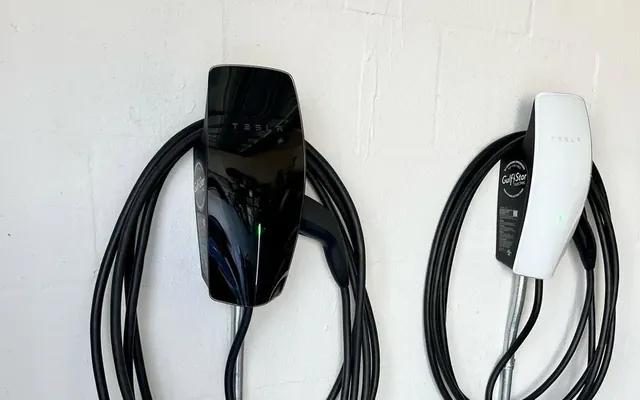
This is one of the most common questions our team is asked: Which should I install? Comparing the Tesla Wall Connector vs NEMA 14-50 Outlet (with Tesla Mobile Connector) is a fairly straightforward comparison:
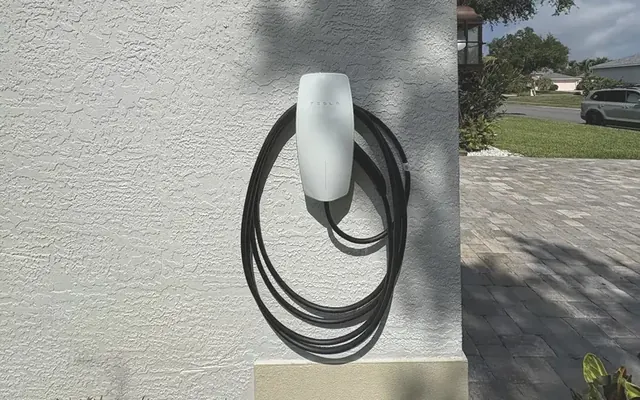
Tesla Wall Connector:
- Fastest possible Tesla charging speed at home for all models
- WiFi connectivity powering more efficient troubleshooting, customer support and smart features
- 48 month equipment warranty
- Efficient diagnostic and warranty replacement process
Tesla Mobile Connector (for use with NEMA 14-50 Outlet):
- Good for on-the-go charging (doesn’t hold up as well with continued daily use)
- No smart features, customer support delays as a result
- 1 year warranty
For these reasons, we suggest the Tesla Wall Connector. It’s more dependable over time and keeps you out of customer service headaches. Renting or in a temporary home? A NEMA 14-50 with a Mobile Connector may suit you better, and you can upgrade later.
For multi-brand or dual EV households (say, a Tesla and a Rivian), we now prefer the Tesla Universal Wall Connector. Its Smart Dock handles both NACS (Tesla) and J1772 (non-Tesla) plugs.
For Most Tesla Owners, the Wall Connector
It’s the more dependable at-home option over time. Renting or in a temporary home? A NEMA 14-50 with a Mobile Connector may suit you better.
Tesla Charging Speed Chart
The fastest models for Tesla charging speed are the Model 3 (Long Range) and the Model Y. Using the Tesla Wall Connector, these cars charge at 44 miles per hour since they are the lightest weight of Tesla’s current fleet.
The next fastest model for Tesla charging speed is the Model S at 41 miles per hour, followed by the Model X at 35 miles per hour.
The Tesla Model 3 Standard Range (also called the Tesla Model 3 Rear Wheel Drive or RWD) is built for efficiency and maxes out at 30 miles per hour, whether you use a NEMA 14-50 or a Wall Connector.
These numbers can change with software updates, and your home’s voltage can make them a little different.
Why Does the Tesla Model X Charge Slower Than a Model 3?
So why does a Model X charge so much slower than a Model 3?
It actually doesn’t, energy-wise. The heavier Model X just needs more energy to go the same distance.
Same energy in, fewer “miles” out, because heavier cars use more.
It’s like a semi truck vs a compact car. You’ll see the same with heavier EVs like the Ford F150 Lightning, Rivian R1T and R1S, or a Hummer EV.
The Electric Vehicle Charger Installation Experts
For over 10 years, we’ve focused on quality residential and commercial electric vehicle charging systems. We’re certified installers and preferred partners for Tesla and all leading EV brands, including:
- Tesla
- BMW
- Porsche
- Mercedes
- VW
- Rivian
- Enphase (formerly Clipper Creek)
- Chargepoint
- JuiceBox
Considering an electric car? Contact Gulfstar Electric for a free assessment of your electrical panel before you buy!